


Hi there, it’s Adam. I started this newsletter to provide a no-bullshit, guided approach to solving some of the hardest problems for people and companies. That includes Growth, Product, and company building. Subscribe and never miss an issue. If you’re a parent or parenting-curious I’ve got a Webby Award Honoree podcast on fatherhood and startups - check out Startup Dad.
Questions you’d like to see me answer? Ask them here.
A few months ago I realized that I was getting an increasing volume of cold email and LinkedIn outreach. Not normally a problem, but the quality of this outreach was abysmal and getting worse. Comically bad. You can see that evidence here and here. The thing is… I know it can work. It has worked incredibly well for me as an early scaling strategy at many, many companies over a 20+ year career. Cold outreach is one of the initial strategies that propelled Patreon’s growth and started its flywheel. Same with sparking initial Lyft demand.
Still, I’m bothered by the fact that most outreach seems to be heading in the wrong direction and it’s going to absolutely ruin it for everybody. I’m fearful that AI is only going to make it worse and make the senders even lazier. To try and fix this I asked my network who the absolute best and most effective people working on cold email outreach are and then reached out to the two experts who were consistently recommended above everyone else. There’s an irony here related to cold emailing… but let’s move past it. I’m thankful that Kellen Casebeer and Noah Adelstein graciously accepted my request to collaborate with me on this post.
Kellen Casebeer is the founder of The Deal Lab and an outbound marketing expert. He works with companies who are looking to build outbound marketing programs or give their existing ones a kick in the pants. Previously he was a VP of Sales and Head of GTM. You can find him on LinkedIn and TheDealLab.com
Noah Adelstein ran Rippling’s cold email efforts in 2023 when they first setup Clay for deeper personalization. He is now leading their entire automated growth function. He also hosts a newsletter and podcast called the GTM Engineer. He operates on the cutting edge of outbound GTM and you can find him on LinkedIn.
Read today’s newsletter to learn:
Why cold email is broken and getting worse
A step-by-step guide to fixing your cold email strategy
Surprising urvey results across in-house and agency cold email senders
In the beginning…
A long, long time ago there was a company called DiscoverOrg that was founded in 2007 by two gentlemen named Henry Schuck and Kirk Brown. Their mission was to “unlock growth potential for professionals and businesses through better data.” They started by gathering actionable business contact information: emails, phone numbers, important contacts, etc. to help sales, marketing and ops teams engage with prospects.
In 2019 DiscoverOrg bought a little company called Zoom Information which had started as Eliyon Technologies in 2000. They rebranded the entire thing (DiscoverOrg + Zoom Information + All their other acquisitions) into ZoomInfo and IPO’d as ZI in 2020. They have since changed their stock ticker to GTM and have a market cap of ~$3B as of the writing of this newsletter.
So why does this matter?
ZoomInfo sells business contact information to companies and has for a very, very long time. This contact information was incredibly valuable in the beginning when no one was emailing people. Reply rates were through the roof in an unsaturated market. But as the Law of Shitty Clickthroughs dictates, eventually people flood the zone and the effectiveness of the tactic inevitably declines. This is what happened with cold email outreach (the irony that the acronym for this is CEO is not lost on me). It is easier than ever to find emails and build the architecture to get them to deliver. So naturally, we get a lot more of them and tune more of them out. For example, I probably get 10-20 emails per day just related to the Startup Dad podcast… and it’s not even that big of a show!
This is unsurprising if you think about the natural progression of commerce and demand. As cave people, we went out and hunted to provide. As civilization settled, trading drove commerce and we had more communal (i.e. scaled) ways of trading our time and effort for needs. Eventually that led to stores and towns and innovation came from door to door sales. The digital age meant we could decouple reach from physical proximity and cold email was born. Cold email scales impressions like billboards along a highway. As the cost of effort has decreased to nearly 0 even with only a 0.1% chance of a win, people will send more emails.

The Problem
As you might imagine from this brief history of cold email, more emails are being sent than ever before. The average office worker receives ~15 cold emails per week.
Today it is the easiest time in history to:
Find someone’s email address (or many emails at scale).
Get them to deliver. Despite deliverability getting harder, the people who send emails have much more to lose or gain than Google does. So they continuously outpace the delivery channels.
Write fake-but-personalized-emails with AI and tools like Clay.
Start a business. This means there are more companies vying for attention in the first place.
Find an agency to help you with cold email. The proliferation of agencies that do this work means you’re compounding the sending because businesses who might have never sent cold emails historically are now sending them (e.g. plant sellers).
On top of this you have two major problems:
Practitioners are getting lazy and
The audience is getting fed up
Problem 1: Laziness
Success in outbound comes down to Message-Market-Fit (MMF). The formula is:
The throughput potency of messaging against an audience

x

Volume of send

x

Channels (i.e. the number of different channels like email, phone, LinkedIn DM, direct mail, etc.)

x

Frequency (do more of this over time and you’ll win with people who previously weren’t interested by wearing them down)
People use the levers they can to win and most people only understand adding volume and channels because it seems like a quick and inexpensive way to drive growth.
They’re all used to throwing more bodies at the problem with SDRs and tools but this has opened the door to people like me (Kellen) outcompeting entire teams via sending 1:many.
What do I mean by this?
Previously, a company might look at a “coin-op” sales process, do some math and assume for every SDR they hire they will get 10-20 meetings per month (on average). They then add incremental reps until they’re reaching their TAM coverage and see diminishing returns. Only one out of ten of those reps is “the best” which means that at most only 10% of the market hears from that person. This leads to a cycle of increasing headcount, people leaders and coordination.
Problem 2: Fed Up Audience
The market’s perception and “how bad it really is” are not synonymous. The irony here is that people say things like “all email is spam” and then are fine with Ramp billboards on buses that apply to <1% of the people who see them [Editor note: guilty].
This doesn’t hurt the advertisers all that much because people still tolerate advertising in the hope that occasionally it’s entertaining or interesting. Bad emails, of which there is an almost infinite supply, make people hate ALL email… even the good ones!
Sending any amount of email will draw some complaints. But don’t equate complaining with “doesn’t” or “can’t work.” It only makes it harder to be successful.
So, woe is me as the cold email sender, right? Not so fast.
It’s not ALL bad in email land…
The good news is that it does still work, otherwise allllll of these people wouldn’t be doing it. It’s also easier than ever to find relevant data AND personalize it against your true ICP without writing horrible and cringeworthy emails.
Let’s take an example:
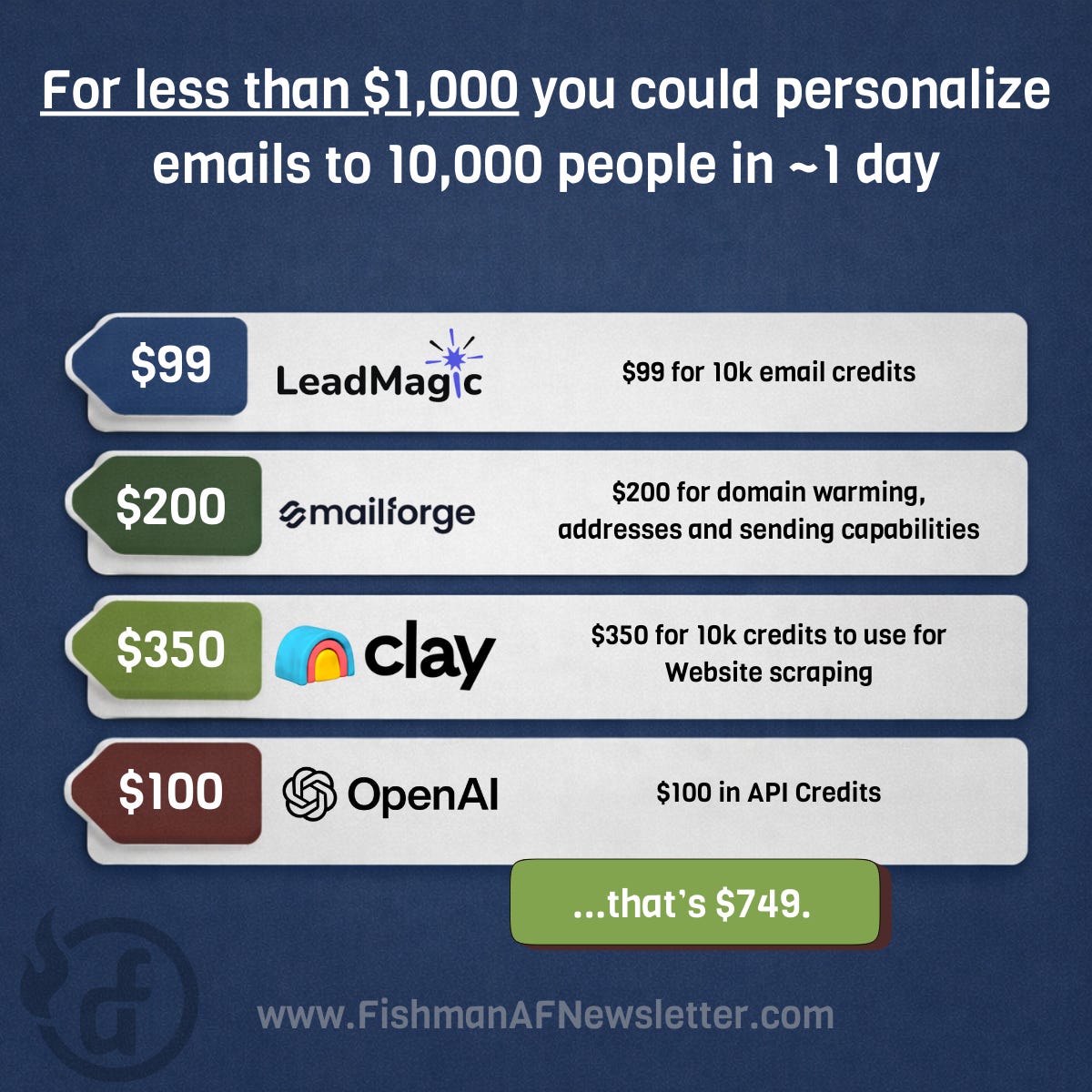
For less than $1,000 you could personalize emails to 10,000 people in ~1 day. Your only blocker would be warming up your sender address across two-three weeks. Let’s look at how this adds up:
Pay $99 for 10K email credits with LeadMagic
Spend $200 on Mailforge for domain warming, addresses and sending capabilities
Pay $350 for 10K Clay credits to use for website scraping
Pay ~$100 in OpenAI API credits
…that’s $749.
To execute you’d scrape the websites of the companies using Claygent, layer on AI to tokenize how you can help their business with OpenAI and then send the personalized emails via Mailforge (or another inexpensive tool like Instantly or Smartlead).
A Step-by-Step Guide to Fixing Your Cold Email Strategy
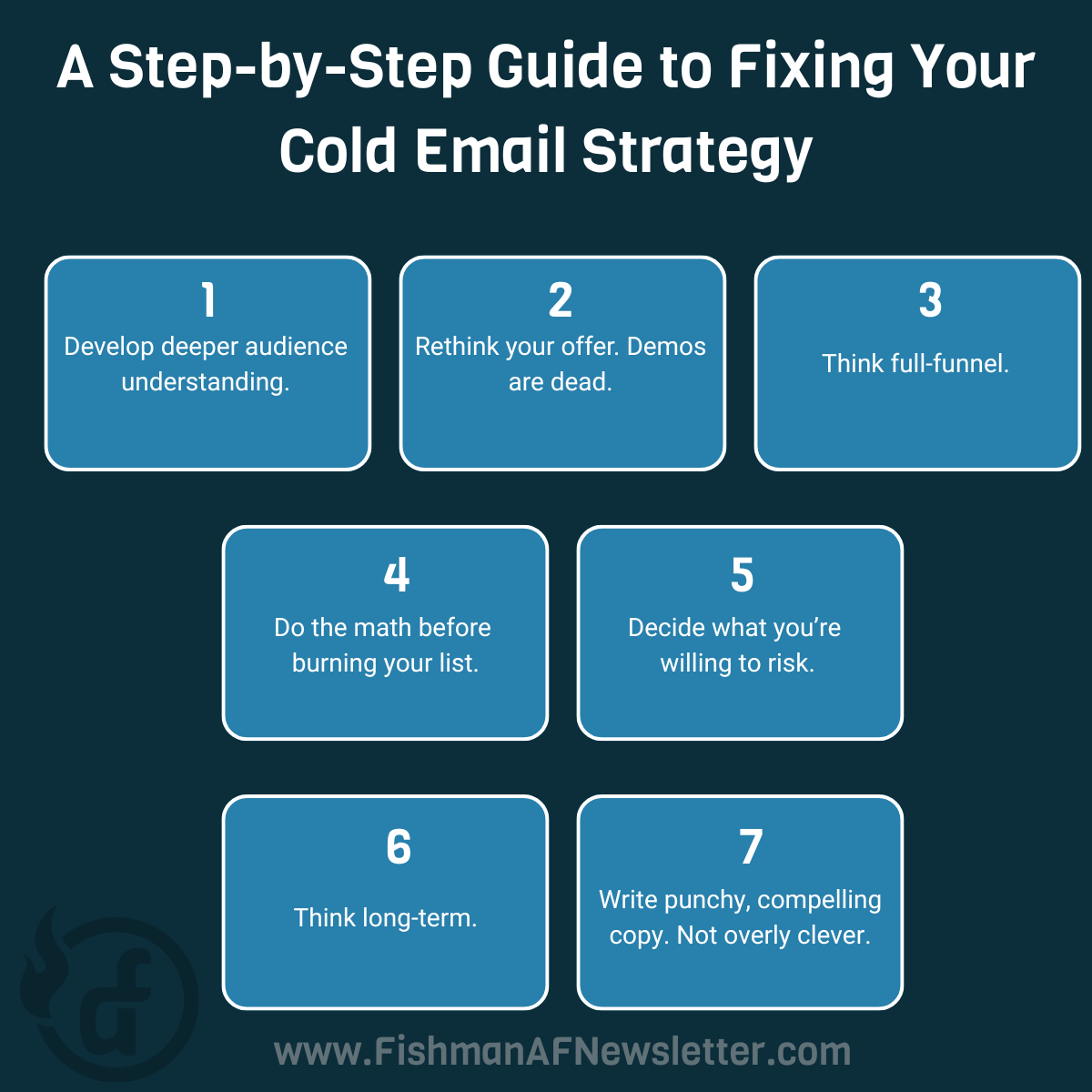
Cold email doesn’t have to be broken. Instead of dwelling on what’s failing [editor note: guilty again, sorry], let’s focus on what actually works. Here’s how to rebuild your approach from the ground up.
Step 1: Develop Deep Audience Understanding
Your market exists whether or not your startup does. Before you write a single email, you need to answer these questions:
Where does your audience consume content?
What exact words do they use to describe their problems?
What is the most acute pain that your product solves?
What “land mines” will immediately signal you’re not worth their time?
This requires nuanced language and cultural empathy. You can’t AI your way to genuine understanding, even with ChatGPT 5.2. You need to do the research yourself.
A few suggestions:
If you have anyone internal who works with customers on a daily basis, go talk to the best reps. Ask:
What pain points do your customers have?
What seems to be trending or top of mind for your customers recently?
What indicates a customer is ready for your product; what sorts of triggers or observable signals might exist?
Do they have to adapt how they communicate to resonate with your specific base of users?
Listen to recorded sales calls or go talk to prospective customers directly. Nothing replaces gathering your own understanding and following your own curiosity.
Spend time in the watering holes where your customers exist.
Brandon Camhi, COO of Netic, who ran marketing at Rippling, also previously worked for a business selling software to home improvement contractors. He would go browse their Facebook groups to see how they communicated and what they found engaging.
Find top influencer accounts that create content for your prospects - be curious about why those people have drawn so much attention. AI can help analyze these accounts and conduct research on your behalf.
Test your hypotheses.
As you get to know your customers there will be a few fundamentally important hypotheses you develop around what makes them tick and why they like your product. Using our home improvement example: maybe you believe they have a lot of FOMO about the competition in their area.
Isolate 2-3 of your strongest held beliefs and go validate them with your sellers or with the customers themselves.
Step 2: Rethink Your Offer (Demos Are Dead)
People are increasingly averse to traditional demo requests. No one has time for it anymore. You need to give them something valuable in exchange for their attention.
Why the demo aversion? Most people don’t like being sold to; especially by salespeople who don’t understand their world. They want to quickly determine if your product solves their specific needs. The rise of product-led growth, self-service tools and free trials have created even more “ick” around demos.
The best offers are:
Valuable to the user
In line and unique to your offering
A strong filter mechanism for who is and is not a good customer fit
Eric from Growth Engine X (an outbound email agency) has nailed this. They offer a free email campaign to prospects before they work together.
Valuable to the user - if it works, they get leads!
In line with their offering - it’s exactly what Growth Engine X will do if they end up working with the client.
A strong filter mechanism - if they can find success with a test campaign up front just imagine how much they’ll accomplish if given more time to ramp on the product, the signals and the users.
For enterprise software businesses that require complex implementations, “trying it out” isn’t as simple. But - there are many creative workarounds:
Do you have proprietary data you can share in an offer?
Can you vibe code an app that’s adjacent to the real product?
Can you pull in one of your partners to provide a faster-to-value solution?
Almost anything is better than a demo; especially for someone not actively looking for one. Taking the time to ideate and test new ways of providing up-front value is a well worthwhile exercise.
A few other examples:
Company that decorates offices offers to send prospective clients a unique item specific to that company’s vibe
An accounting software business offers a free audit
An SEO firm does a comprehensive assessment of your opportunities
Step 3: Think Full-Funnel
Email is much improved with a multi-touch approach. Here are a few additional touches you can leverage:
Strategic gifting
LinkedIn connection requests
Valuable content sharing
Other touchpoints that build relationships before the ask [editor note: generic flattery about my podcast content doesn’t meet the bar here].
Step 4: Do the Math Before You Burn Your List
Before sending a single email, calculate whether this channel can actually work for your business. Even though cold email has the potential to be a great channel there are some businesses where it just doesn’t make sense.
Calculate your monthly email capacity:
Determine how many people are in your total addressable market (TAM)
Decide how many times you can sequence them per year (3 is a reasonable baseline)
Divide by 12 to get monthly volume
Example:
10,000 people in TAM × 3 sequences per year ÷ 12 months = 2,500 emails per month
Not sure about your TAM size? Figure out how many domains exist in your market, run a sample of 5,000 through enrichment providers, then apply that ratio across the remaining domains. Just be careful to choose a representative sample, not just the best domains.
Calculate your revenue upside:
How much revenue would this channel drive if you got 1 successful engagement out of every 50 sends? Every 100? 500? 1,000? Use these benchmarks to determine what success would need to look like for the revenue upside to justify the investment.
Many businesses try email with TAMs or deal sizes that are simply too small for it to be viable. Or, they get started on cold email and don’t have the proper bar they need to reach for the channel to be successful. Understanding the full picture helps you decide whether the potential return is worth the time, money, and brand reputation cost.
Step 5: Decide What You’re Willing to Risk
Every email you send is a trade. You’re exchanging potential short-term gains for long-term brand equity. Opt-outs never come back and a tarnished brand almost never recovers.
Be honest about what level of success you’re okay with in exchange for potentially burning your email list and/or damaging your brand. If you’re not sure about response rates you can do a small test to get a statistically significant sample size and tighten your estimates.
Step 6: Think Long-Term
If you want to maximize revenue over 5 years, don’t email everyone in your database in month one.
Be strategic with your timing: if your product will improve over time, or if your downstream unit economics will get better, you might want to hold certain segments for later. There’s calculus involved in deciding when to go harder on email and when to hold back.
The businesses that win at cold email aren’t the ones sending the most emails today. They’re the ones building sustainable, self-reinforcing, systems that generate revenue year after year without destroying their market position.
Step 7: Write Punchy, Compelling Copy
You can nail the audience, email warming, offer and strategy… but if your copy is weak then it’s all for naught.
Here are a few tips to writing great copy:
Make it real
If you’re going to mention your company’s value props in an email, get specific. Instead of giving a blanket statement, bring it back to a real world example that identifies and acknowledges the pain you uncovered in your research.
Don’t do this: “We can help you automate HR, payroll and IT”
Do this instead: “Onboard employees in 90 seconds across laptop access, tax documents, 3rd party apps (Slack, Office, etc.), and more”
Stick to ONE simple CTA
Don’t ask the user to do too much. Provide a simple single action point for the user to take.
Do this: “Reply yes if you’d like to try out our calculator.”
Test unique styles of writing
How can you make your emails stand out? It could be a two-liner, adding a GIF (sometimes it doesn’t hurt deliverability as much as you’d think), using unique language/tone, etc.
Anything you can do to disrupt the pattern of someone going through their email and hitting “delete” will dramatically improve your replies.
Editor note: Don’t get overly cute on this one though. Nothing makes me want to spike an email into the junk folder faster than someone giving the appearance of trying too hard.

Cold Outreach Survey Results and Benchmarking
If you’re looking for some benchmark data around cold outreach, specifically email, look no further than the survey we conducted to in-house and agency cold email senders.
Collectively the participants are responsible for ~3-4 million monthly email sends. Here are some highlights:
Average sequence length: 2.97 emails per sequence
84% never or only occasionally use LinkedIn touches in their email sequences (we see this as a huge opportunity for multi-touch campaigns still)
AI usage: 75% of senders are using AI to write snippets of their emails BUT only 7% are using AI to write the entire email
Reply rates: average reply rate is 3.2%
71% used more than one lead vendor with Apollo as the #1
31% used more than one validation vendor with LeadMagic as the top provider
Conclusion and Future Outlook
This post represents what the best practices are today but, as with most tactics, we’re in fast-moving waters right now and this could change in six or twelve months. Ideally, we’ve captured enough that is long-lasting and sustainable through changes in the landscape.
As we look to the future, we have some questions and thoughts about what “cutting edge” will look like:
More and more we will have core architects of these email systems and fewer, low-tier practitioners collecting a paycheck to copy paste failing messaging. The market should be excited about how much this is accelerating - “survival of the fittest.”
There will always be new entrants that try to win, send awful messages, and make others look bad.
B2B companies need to grow, it is valuable to test and refine messaging, in our opinion email is “Lindy” and here to stay.
Some questions to ask yourself:
Is there a future where AI sits on top of the inbox evaluating responses and we end up with two AIs talking to each other and deciding what to filter through to the human? If you look at the number of “AI Inbox Assistants” the answer is: most certainly.
How do you build a model that improves over time based on the learnings of what you send? The self-analyzing feedback loops that an email agent should be able to execute will make a big difference here.
How do you build a brand and opt-in email list to nurture over time as email quality and copy eventually commoditizes?
This last question is most interesting and probably the one that cold outreach senders will have to wrestle with the most in the coming years. The solution may lie in Step 2 from above: rethinking your offer. Those who strike a good ratio of value creation to value capture will be more likely to hold people’s attention and interest over a longer period of time.


Brilliant framing on Message-Market-Fit - breaking it down into messaging potency x volume x channels x frequency is way clearer than the vague "personalization" advice floating around. The audience research section feels particularly timely because I've seen so many teams skip straight to Clay personalization without actualy understanding the culture. The calculator showing sub-$1000 for 10K sends was eye-opening honestly, explains alot about inbox saturation.
AI has removed the constraint of producing outbound messages, but resonance has always been the core challenge. Do you think the next step is moving from general audience insights to understanding each individual prospect’s situation, so messages are based more on real-time context rather than persona level assumptions?