

How To Build A Better Feedback System For Professional Development
Most managers aren’t trained to give useful feedback. Employees: make it easier to extract. Managers: build a process that produces something better than “be more like me.”

Hi there! It’s Adam again. As a reminder, I started this newsletter to provide a no-bullshit, guided approach to solving some of the hardest problems for people and companies. That includes Growth, Product, and company building. Something on your mind you want advice on? Reply and let me know.
I also have a fun and educational podcast about the intersection of company-building and fatherhood. It’s called Startup Dad and you can check it out here.
Someone forward this to you? Don’t be shy and subscribe here.
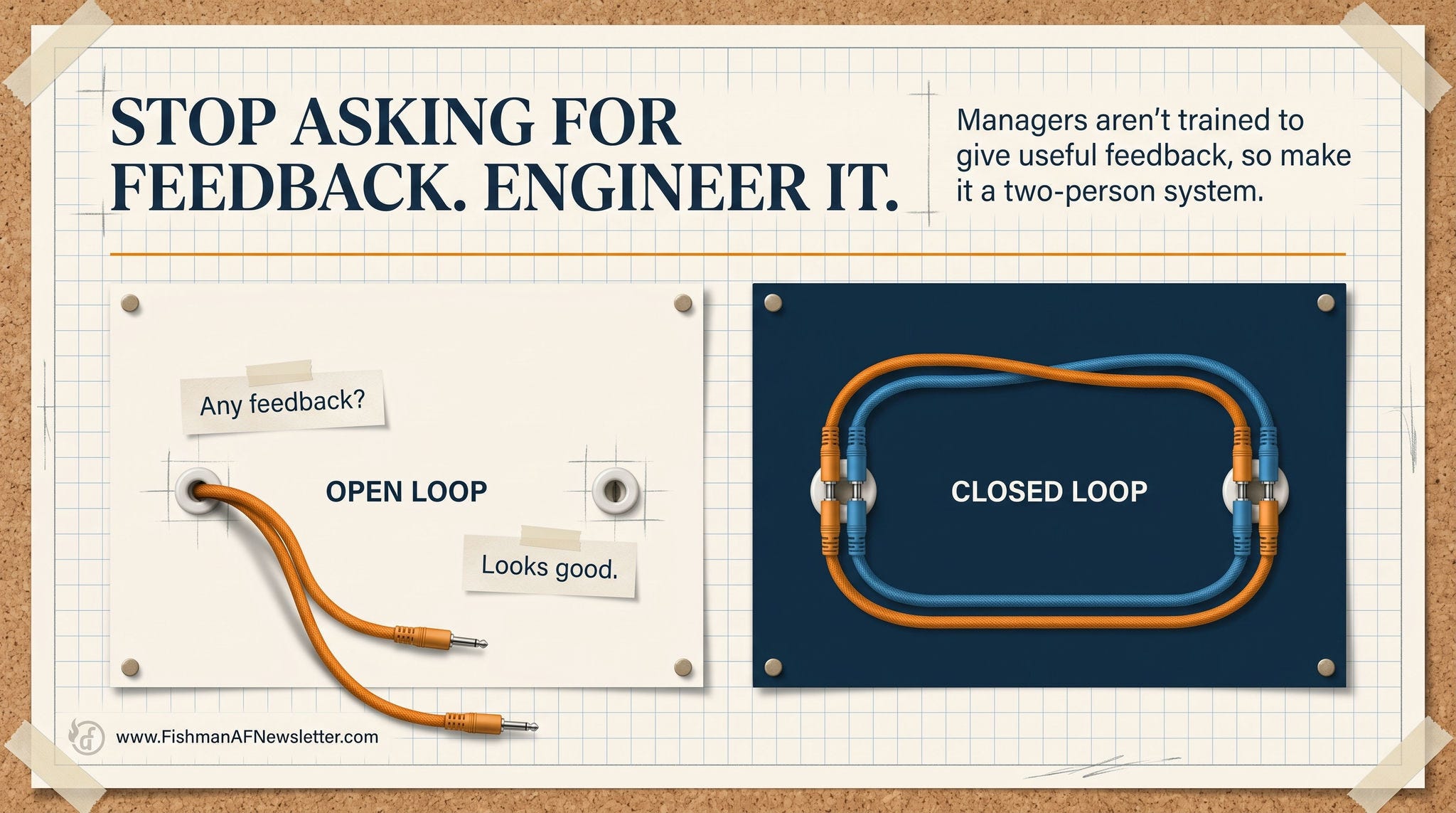
The worst feedback is not negative feedback.
Negative feedback at least gives you something to work with.
The worst feedback is the soft non-answer from someone whose opinion you respect and want.
“How did that go?”
…
“Good… I think.”
That sentence is brutal. It sounds positive while giving you no useful information. It tells you nothing about what worked, what almost broke, what your manager wants repeated, or what you should change next time.
You leave the conversation technically reassured and practically unchanged.
This is where a lot of career advice gets too simple or generic. The standard advice is: ask for feedback.
Okay, cool, that’s fair. As an employee you should ask.
But “ask for feedback” assumes the main problem is that your manager forgot to give it. Managers don’t forget to give feedback. They don’t give it because feedback is socially expensive and most managers aren’t trained to deliver it well. They’re not trained at all, in fact. It makes them uncomfortable.
Employees aren’t helping either. “Do you have any feedback for me?” asks your manager to search their memory, evaluate your performance, organize their thoughts, decide how honest it is safe to be, and deliver a potentially uncomfortable message. All in real time. Speaking from my own personal experience: I am not good at this. I don’t know many who are.
Even thoughtful managers struggle with this. Poor ones, in an effort to fill the uncomfortable silence, reach for whatever happened most recently, give you the compliment sandwich, or offer advice that amounts to “be more like me.” This last part is what I’ve seen from my own managers time and time again.
Unfortunately, you (employee) can’t make somebody have a hard conversation. We’re wired to be liked and sometimes giving you honest feedback means the other person doesn’t like you for 30 seconds. Or… maybe a week?!?!?
But all is not lost. You can design a better conversation. Or as the title of this newsletter implies, you can engineer it.
The question to ask is: “How do I build a feedback system around myself when the person responsible for feedback is unreliable, uncomfortable, or vague?” BTW, it’s not that they’re a bad manager or a bad person. They just need help.
Building a feedback system requires work from both sides. If you’re asking for feedback (and again, you should be), you can create more places for useful signals to appear. If you’re the manager, you can stop treating feedgack as an improvised performance or interpretive dance (look, I’m a tree!) and prepare for it like the consequential conversation it is.

Increase your feedback surface area
If your manager is vague, why would you ask them a vague question?
“How am I doing?” invites a broad (usually useless) answer. Narrow the request by giving your manager a format, a period of time, or a piece of work to evaluate.
Think of this as increasing your feedback surface area: creating more places where specific, useful observations can show up.
Here are five ways to do it.
1. Ask for a written Top 3 / Bottom 3
Most people write better feedback than they speak, particularly when the subject is uncomfortable.
Live feedback asks the manager to do two jobs at once: formulate an honest assessment while managing the employee’s reaction to it. Writing separates those jobs. It vies the manager distance, allows them to find evidence, and lets them revise the sentence before you see it. As a manager I almost always write out feedback before I verbally give it to someone.
Instead of putting your manager on the spot, ask:
Can you write down the three most effective things you’ve seen me do and the three most important opportunities I should work on?
Even better:
Can you write down the three most effective things you’ve seen me do [in X specific area] and the three most important opportunities I should work on? I think I have opportunities in [fill-in-the-blank] area; do you see the same thing?
This constraint forces prioritization. “Good job” is no longer sufficient; they have to name what was good. The Bottom 3 also normalizes critical feedback as part of the format rather than an unexpected personal attack. You’re inviting it so it has opened the door!
The Top 3 matters just as much (maybe more?). Development isn’t only about repairing weaknesses. You need to understand which strengths are producing results so you can lean into them. It is often much easier to lean into your strengths than to fix a weakness.
There’s nothing magical about the number three (other than it’s a common communication framework - “Rule of 3” anyone?!?!). The constraint is the point of this exercise because you want your manager to identify the very small number of things that matter most.
And make sure to ask while the evidence is still available and fresh: after a launch, strategy review, executive meeting, customer escalation, cross-functional push, etc. People retain the general vibes of a project for much longer than the behavioral details.
And I guess these days we can code on vibes (iykyk) but you want the details.
2. Turn it into a retro
Feedback gets infinitely harder when it sounds like a verdict on the person.
“You need to communicate better” feels like a trait judgment. It can mean almost anything, which makes it simultaneously uncomfortable and useless.
Enter the retro! Huzzah!
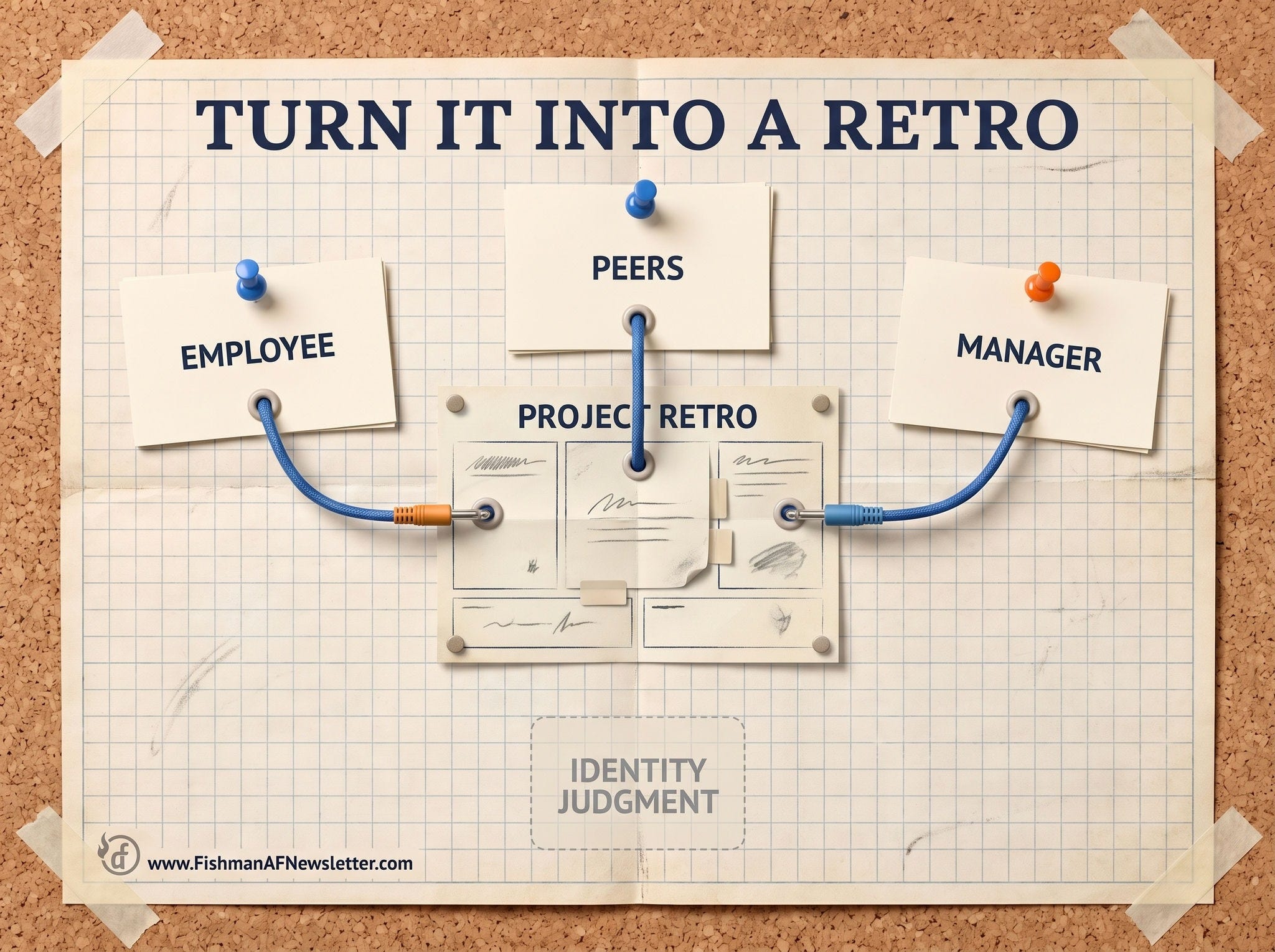
A retrospective changes the object of discussion. Instead of asking your manager to evaluate you, ask them to examine the work with you:
Can we spend part of next week’s one-on-one discussing what went well on this project, what didn’t, and what I should do differently next time?
This moves the conversation from identity to evidence. You’re no longer asking, “Am I good?” (trait judgment). Now you’re asking “What happened in this system and what should we change?”
One other note on this technique…
You’re planting the seed for a future discussion. In the PESOS model for difficult conversations which I wrote about ages ago the “P” stands for permission. It’s a technique that keeps people from feeling off guard which suppresses the “fight or flight” instinct. As silly as it sounds… GET PERMISSION TO GET (and give) FEEDBACK.
But Adam, how do I do this magical retrospective?!?!?
Glad you asked. Follow the KISS method (keep it simple, stupid):
What went well?
What was harder than expected?
Where did I create clarity?
Where did I create drag?
What should I repeat?
What should I change next time?
The more concrete your ask, the better the feedback.
“How am I doing?” invites vibes. We don’t want vibes here.
“How did the product review go and specifically where did my narrative lose the room?” invites details. Remember: we want the details.
Run the retro monthly or after consequential pieces of work. Just like you’d run a product launch retrospective or a post-mortem. Don’t wait for the annual performance calendar to decide when you’re allowed to learn.
3. Self-evaluate first
One of the easiest ways to get better feedback is to do the first draft yourself. I know, I know, this sounds like enabling the laziness of your manager. But recall that mangers have so many more reps responding to something at this point in their career than creating it from whole cloth. They also don’t know your entire, detailed work portfolio. It’s impossible to.
But yes, this sounds backwards. If the point is to get your manager’s assessment, why start by offering your own?
One reason: reaction is easier than invention.
Your manager may have a feeling but not a sentence. They may not know where to being or how direct to be. Your self-assessment gives them something concrete to confirm / reject / sharpen. It’s another way of offering permission.
Try:
My read is that I did a good job getting the team to a decision, but I over-rotated on context and buried the recommendation. Did you see it the same way? What am I missing?
You’ve reduced your manager’s burden without letting them off the hook. They no longer have to invent the entire critique or drop something that is surprising / out of left field. Instead, they get to engage with your diagnosis.
The other benefit is that self-evaluation builds your own judgment. If you consistnetly predict what worked and what didn’t you’ll see patterns start to emerge. Maybe your analysis is strong but your recommendation arrives too late. Maybe you influence well one-on-one but lose effectiveness in groups. Maybe your documents are thorough but not decisive. This is also training you for potential management and it’s great practice. Self-evaluation and 360 feedback are what propel the majority of your career so learn to use them to your advantage.
Your manager’s feedback matters but your ability to anticipate valid feedback matters even more over time.
4. Ask sideways
Sometimes your manager isn’t the person with the best signal. They’re not in the trenches with you working on that project; they just get occasional updates and feedback if someone has an issue with what you’re doing.
Managers regularly (and unfortunately) see only the polished output: the final document, roadmap review, exec summary, or launch readout. Your peers see the messy middle. They experience the tradeoffs, collaboration, unclear decisions, and moments when you either helped the group move forward or made the work harder. Your superpower will be learning to leverage your peers.
Ask the people who were arm in arm with you in the muck:
I’m trying to improve how I lead cross-functional work. Could you send me the Top 3 things I did that helped this project and the Bottom 3 things that made it harder? Be brutally honest; I can take it.
Peer feedback has limitations of course. It can be too local, reflect someone’s personal preferences, or miss the broader organizational context your manager sees. But it often contains more behavioral detail that your manager won’t have and it can be better at surfacing your towering strengths.
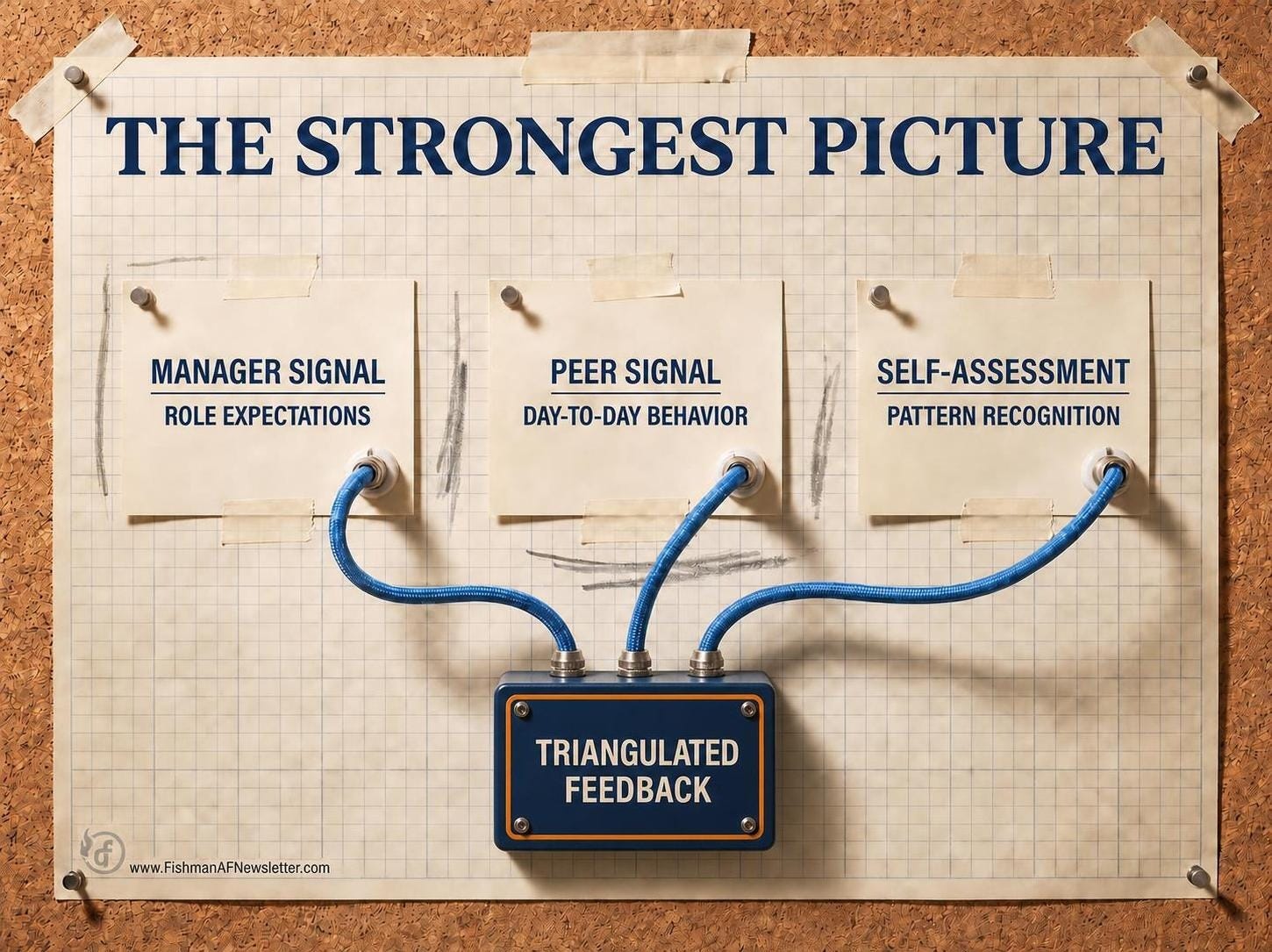
Use it to triangulate rather than shop for the answer you want:
Where do several people see the same strength?
Where does the same friction appear in different forms?
Where does your manager’s assessment conflict with the team’s operating reality?
5. Build an AI Manager Mirror
Hey, we’re in the AI era now right?!?!? What newsletter wouldn’t be complete without a reference to that magical technology? There’s another source of feedback available now and getting better by the week: a lightweight simulation of your manager’s recurring critique and feedback patterns.
The useful version is not, however, an impersonation of your manager. AI is better as a rehearsal partner that recognizes the kinds of questions, risks, and objections your manager has raised before.
Alllllllll managers have patterns. Some consistently ask whether the recommendation is clear. Others push on the quality of the evidence, unnamed tradeoffs, unclear ownership, operational follow-through, strategy, or whether cross-functional partners were involved early enough.
Build your pattern bank from:
Prior performance feedback
Comments and edits on documents
Questions they repeatedly ask in meetings
Examples of work they’ve praised
Examples they pushed back on
Your own notes after one-on-ones (Granola’s MCP is excellent for this btw)
Then ask any AI tool to 1) create the pattern bank and 2) evaluate a sanitized version of your work through those patterns:
You are a critique simulator based on recurring feedback patterns I’ve received from my manager. You are NOT my manager and should not imitate their identity. Identify likely objections, missing context, unclear recommendations, underplayed risks, and questions I should be prepared to answer. Separate likely concerns based on the supplied patterns from your own uncertain inferences. Give it to me straight and direct; be kind but firm.
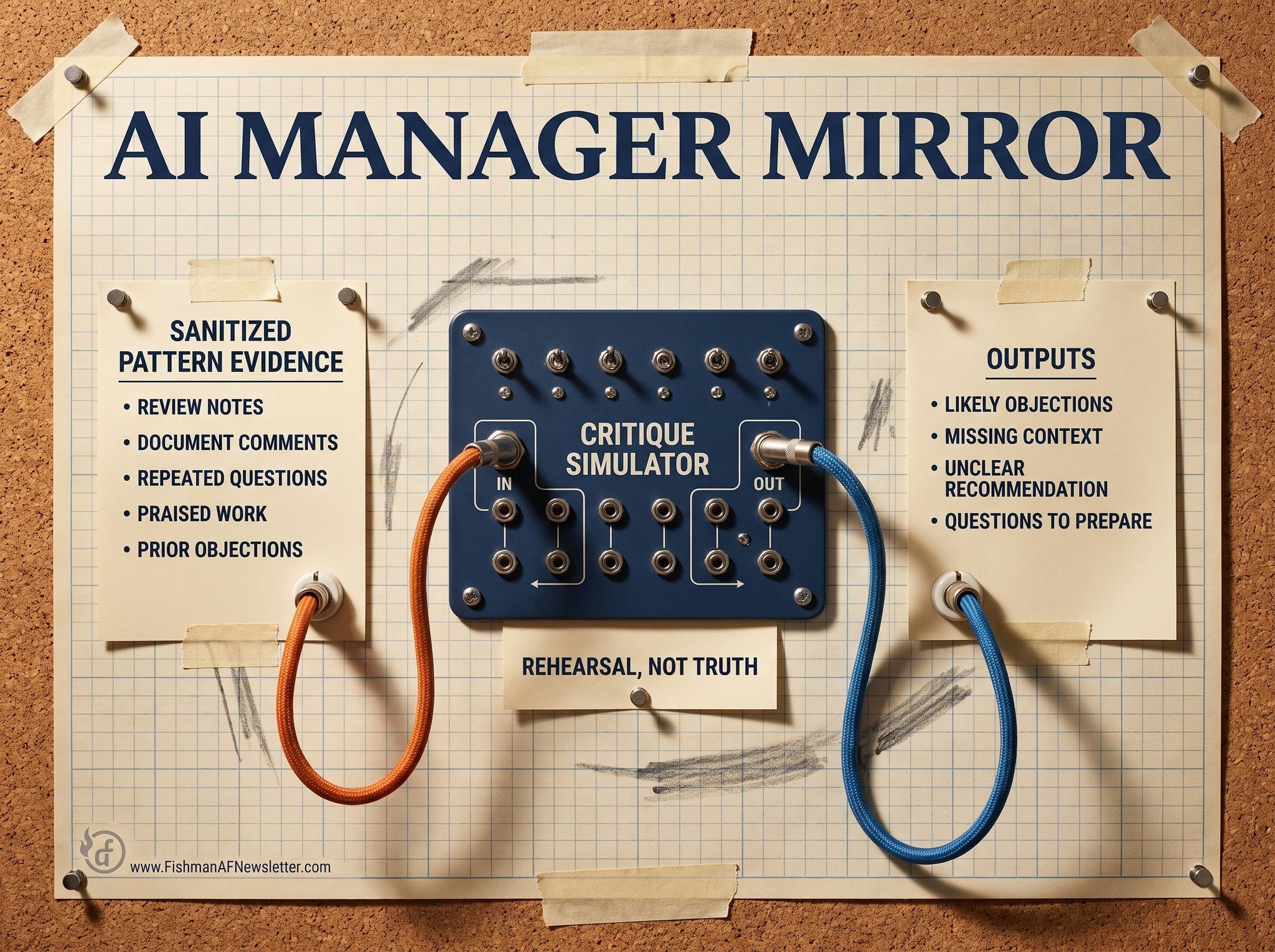
This can help you rehearse before a strategy review, pressure-test a recommendation, or notice that you’re repeating an old mistake.
It can also go horribly, horribly wrong.
Don’t upload confidential company information. Remove customer names, proprietary strategy, internal numbers, and sensitive context. Don’t treat the output as ground truth. Compare its predictions with actual feedback and adjust the pattern bank over time.
Most importantly (!) don’t optimize your entire career around one manager’s preferences. Even a human one. They’re helpful, but you won’t be working with them forever. The goal is NOT to install one person’s voice permanently in your head. Be a product manager here: take it as helpful input and context, but not the gospel. A tool, not a rule.
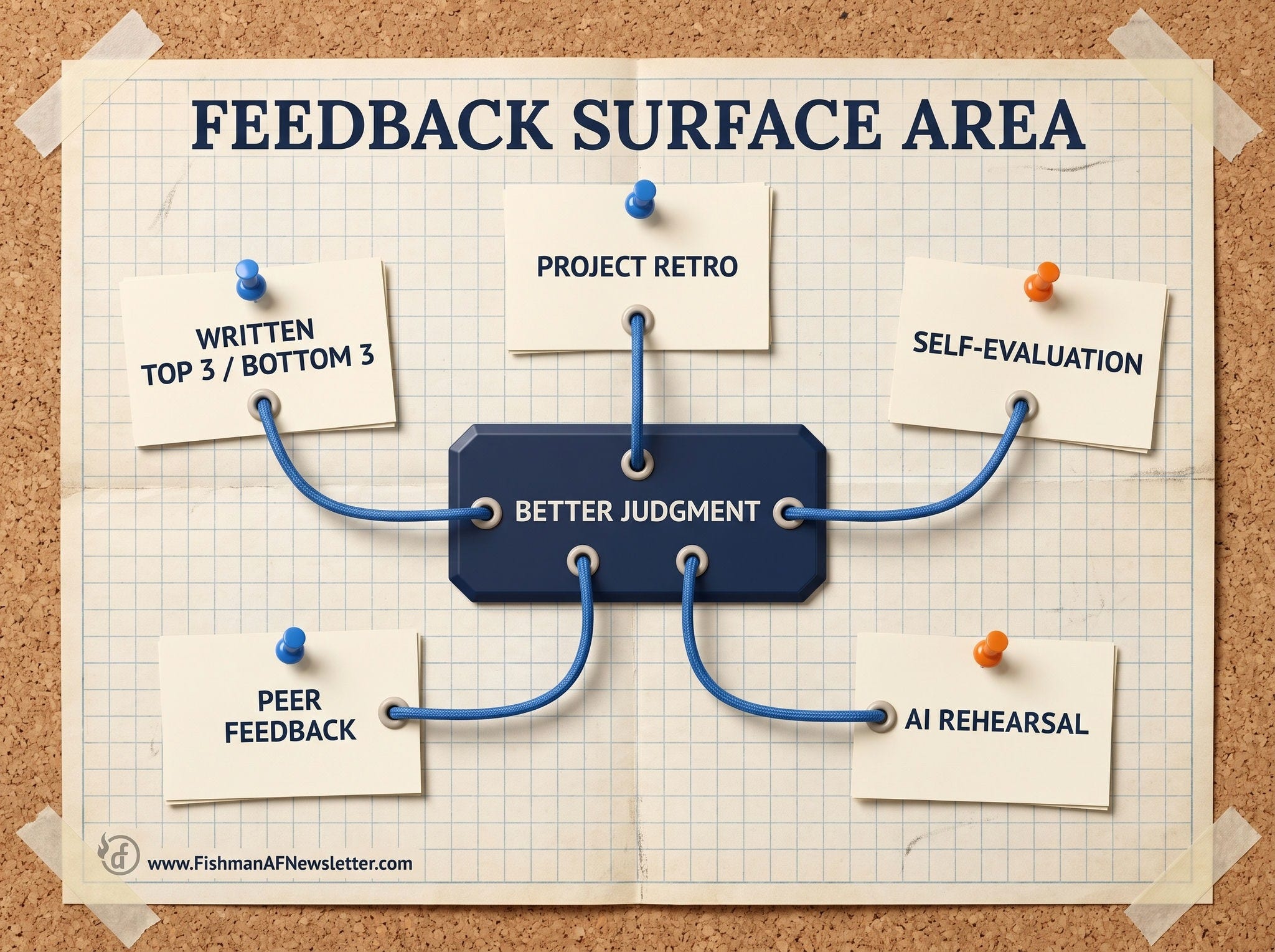
In summary, as a framework for engineering better feedback:
Ask for a written Top 3 / Bottom 3
Turn it into a retro
Self-evaluate first
Ask sideways
Build an AI Manager Mirror
The multiplier: give them time
I alluded to this earlier with “permission” but there’s one significant multipler across all five tactics: give notice.
No one likes to be ambushed with a request for deep feedback. As I mentioned, it triggers fight-or-flight and you’ll get almost no depth in the response.
I learned this from being on the other side of the conversation.
Story time…
I’ve been a manager for a very long time; over half of my 20+ career. A senior IC on my product team once asked me for substantive career and organizational guidance after I had only been at the company briefly and had managed them for a handful of weeks. They were hungry for feedback (good!). I wanted to help (also good!). But I didn’t yet have enough evidence to offer anything useful.
So I punted.
More precisely, I told them I needed time and committed to coming back:
It sounds like you’d really like to get some feedback from me, and I’d love to give it to you. I just need some time to prepare that feedback so that it’s effective and clear. Can we set a date to follow up on this?
(feel free to reword so you don’t sound stiff; I paraphrased something like the above).
Postponing feedback isn’t bad management but postponing it without an accountable return plan definitely is.
Because I knew this person wanted substantive guidance I started taking more detailed notes on the behaviors I observed. I went back through our 1x1 conversations, examined the expectations of their current level and what the next level required (side note, if you’re still figuring out leveling… give this a read). I reviewed feedback they had received before and asked myself whether each point was still valid, already solved, or still needed work. AND, I asked for their most recent self-evaluation.
That preparation allowed me to identify specific strengths and opportunities instead of producing an impressionistic, snap-judgment based on only a few weeks of conversations.
Many managers won’t initiate this process themselves. Especially if they just started working with you. You can create the conditions for it with a request like:
In our one-on-one next week, I’d like to spend 20 minutes on feedback from the last launch. I’m going to send you my self-assessment and would love your Top 3 / Bottom 3 before we meet.
That prompt gives them a time, a format, an artifact, and permission to be specific. It also tells them you’re serious.
Preparation beats being put on the spot. If I need to give someone useful feedback, I often write, delete, rewrite, check the actual artifact, compare my memory with what happened, and then tighten the point. The first version is never the best version.
Why would we expect managers to produce great, in-depth feedback instantly in a 30-minute one-on-one between two other meetings and a bathroom break?
Advice For Managers
Lest you think I’m letting managers (myself included) off the hook… THINK AGAIN!
Stop improvising
Most managers aren’t trained as managers.
They may have been promoted because they were excellent individual contributors, built an important function, navigated a reorganization, or happened to be standing in the right place when leadership needed someone. Their path may contain useful lessons but it is not automatically a template for someone else’s career.
That is how managerial feedback becomes “be more like me.”
The manager describes the tactics that worked for them not the behaviors and outcomes the role requires. Managers: we live in a different timeline than the one you did when becoming a manager. For managers dispensing the “be more like me” trope: confidence becomes speaking like they speak. Strategic thinking becomes using their planning process. Executive communication becomes adopting their presentation style.
I’m not advocating that managers should remove all of their own judgment from the feedback levied. Just ground it in some actual evidence.
When I know someone wants substantive feedback, I use a deliberate preparation process:
Take notes on observable behavior across the relevant period.
Compare those behaviors with the expectations of the person’s current level and the next one.
Review earlier feedback and decide what remains valid, has been resolved, or still needs work.
Distill the evidence into a small number of strengths and opportunities.
Attach concrete examples to each point.
State the limits of the period I can credibly assess.
Seek additional context from folks who worked with that person.
My informal structure then becomes Top 3 / Bottom 3. It grounds people in a handful of important points: what they should lean into as a source of strength and which opportunities require attention.
I don’t sugarcoat the message and I make sure that my directness is backed up with evidence.
Sometimes I have months of examples. Sometimes we haven’t worked together recently and I need to say that my evidence covers a narrower time window. Managers should be honest about hte limits of their view to avoid laundering a few observations into universal truth.
Define the requirement without prescribing the personality
In one conversation I had with a senior IC the strength and opportunity were very closely connected.
The person had deep technical expertise and was already providing strong, non-territorial leadership. They had accurately diagnosed operational problems, helped other understand technical tradeoffs, and guided teammates without forcing their position.
The opportunity was to make that leadership more visible and consequential: state a viewpoint, exercise decision authority, influence partner teams more directly, and move beyond executing assigned work to helping better define where the work should go. This may sound a bit like “be more like me” but it was grounded in the expectations of the next level of the job which anchors on company-wide influence. You can’t influence super well from the shadows; especially not the leaders.
“Be more strategic” would have been useless feedback. We made it concrete:
Develop a point of view on the available paths.
Explain the risks, rewards and tradeoffs.
Decide which bets the team should place.
Articulate why the produce would be differentiated from the competitive set now and into the future.
Create meaningful scope rather than waiting for it to be assigned.
Influence the organization sideways; not only through the reporting chain.
Their strength was a strong trajectory, trusted leadership and credible promotion potential. The opportunity was to shift from executing important work to defining strategy, creating scope, steering major bets, and influencing the broader organization (and executives).
In this case, the opportunity amplified an existing strength. But that won’t always be true.
Some expectations are non-negotiable at senior levels: creating strategy, getting work done through peers and influence, and communicating effectively upward and sideways. A person may have enormous, towering (!) strengths elsewhere and still need to close one of those gaps.
But back to the managerial mirror. The guardrail against “be more like me” is to separate the required outcome from your own preferred method.
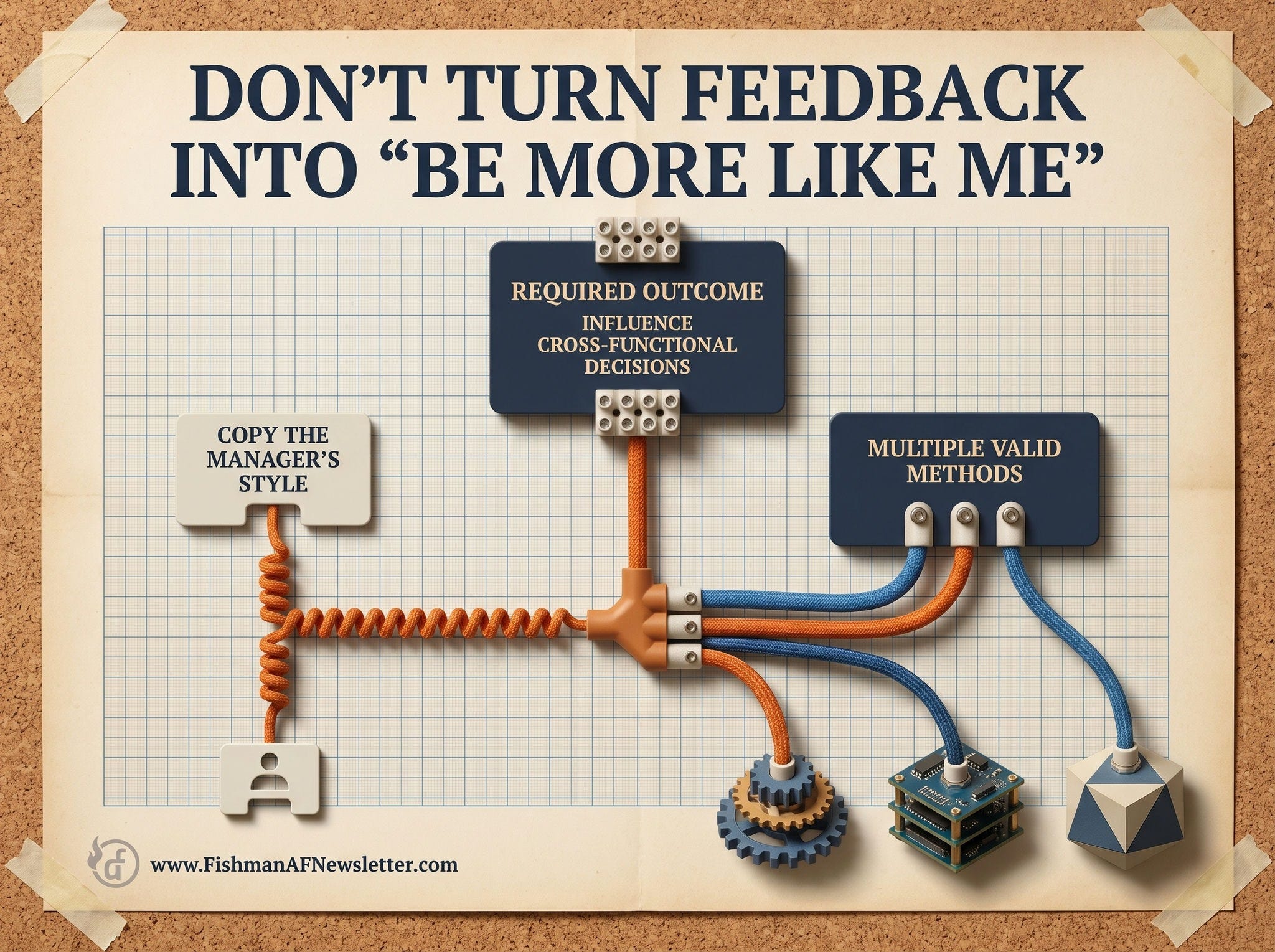
There are many reasons I reached my own leadership position and some of them were indeed “right place, right time, right company.” When I give feedback, I try to ground it in observable behaviors and outcomes instead of treating my own career path as doctrine.
And I’m always clear with teammates that how you do the job matters less than whether you achieve the behavior and outcome the role requires.
I’ll still offer suggestions:
This is how I’ve achieved that; your mileage may vary. What do you think? What would you like to try?
That keeps the standard quite firm but the method collaborative.
Even with the best delivery it can still be a challenge to know that the feedback was received, internalized and understood…
How to know the feedback landed
A person saying “thank you” doesn’t tell you a whole lot. People thank managers for confusing feedback all the time (side note: please don’t do this, people).
A better signal is whether they (your feedback recipient) can play it back.
Ask the recipient what they heard. Let them clarify, disagree, and add context. Their response may expose a vague phrase you need to tighten or an example / situation you interpreted incorrectly. In fact, it almost always will do one of those things.
That exchange actually makes the feedback stronger and more accurate.
There’s a progression:
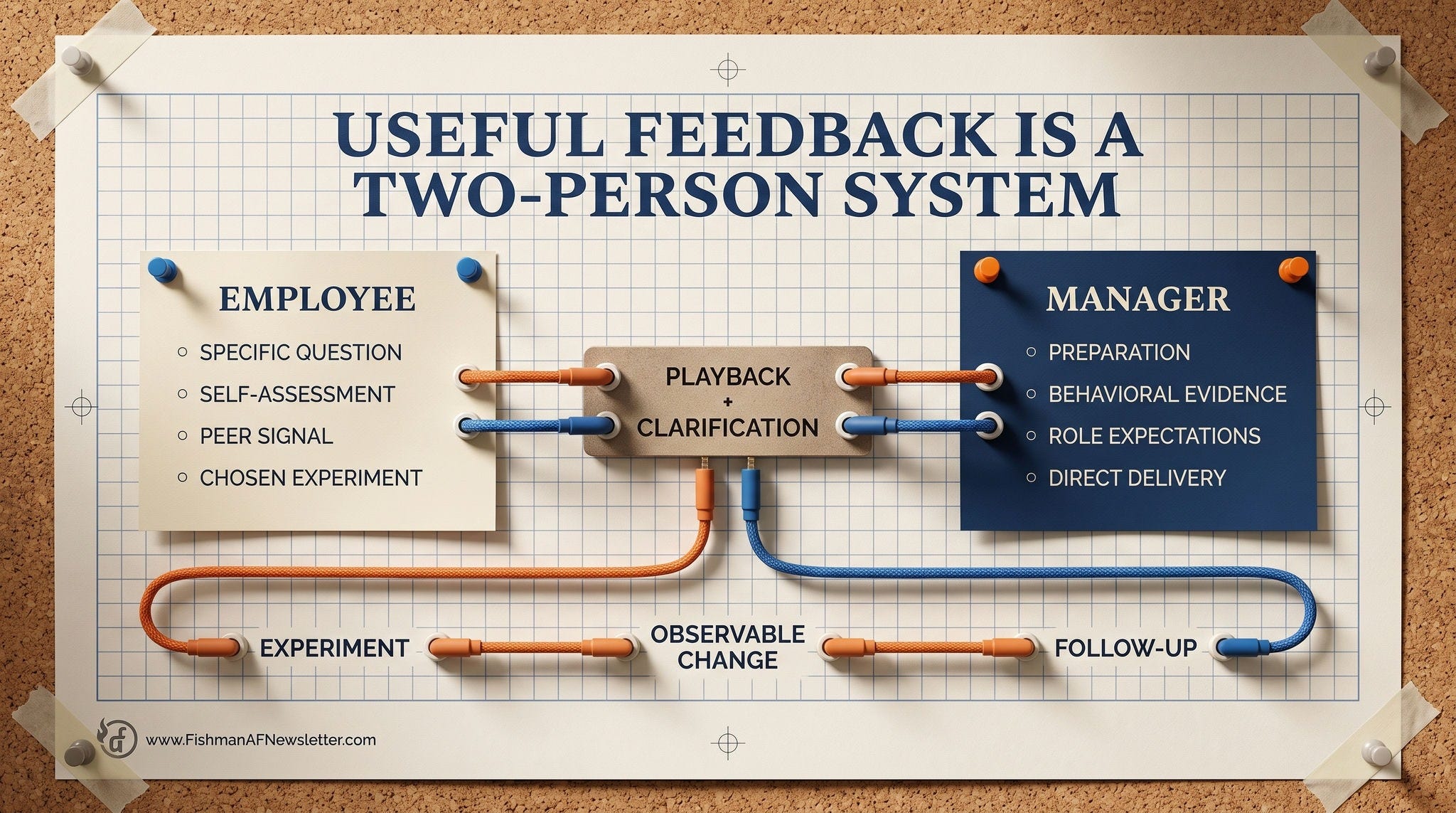
Appreciation suggests the message was received.
Playback demonstrates comprehension.
Clarification improves accuracy.
A chosen experiment demonstrates commitment.
Observable change demonstrates impact.
Then to close the loop decide what the recipient wants to try, what progress would look like, and when you’ll revisit. Put it on the calendar (calendar is destiny!!!).
I usually set a monthly or quarterly follow-up date depending on the feedback OR ask the person to push updates to me. I prefer the latter for more senior people. It takes some burden off the manager and the recipient doesn’t feel micro-managed. Most importantly: owning your development is itself a skill senior employees should build. GET CRACKIN’ FOLKS.
Don’t let the ownership be ambiguous. Put the date on the calendar; state the expectation clearly; ask the employee to set a reminder. If they agree to own the follow-up and never return, that is a larger issue that requires its own feedback.
The Shared Feedback Protocol
Useful feedback is a two-person system.
Managers: you owe the employee preparation, clarity, evidence, and candor.
Employees: you own seeking signal, testing it against other evidence, and converting it into action.
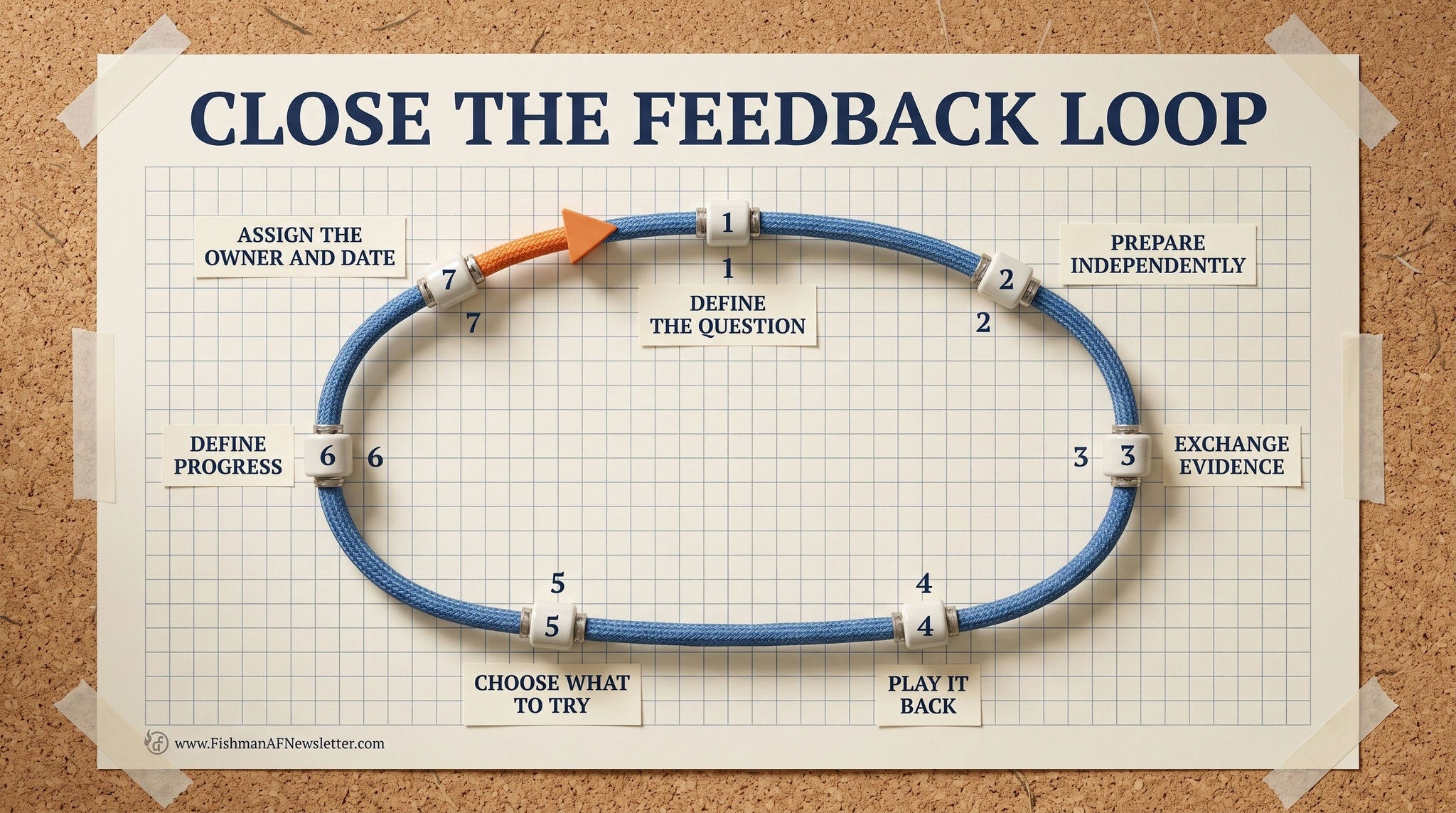
A useful feedback loop has seven parts:
Define the question. Are you evaluating a project, a decision, current performance, promotion readiness, or a particular capability.
Prepare independently. The manager gathers examples, reviews role expectations, and checks earlier feedback. The employee arrives with a self-assessment and has shared it ahead of time.
Exchange evidence. Discuss observable behaviors, their consequences, and the outcomes the role requires.
Play it back. The employee restates what they heard; both people clarify anything vague, unsupported, or disputed.
Choose what to try. The manager can offer approaches without requiring imitation. But don’t start there; let the employee / feedback recipient propose some ideas. Then they select an experiment or next move which could be from their own ideas or from the manager’s. Also, manager, if you don’t like an idea they come up with or select please tell them so.
Define progress. Agree on the observable evidence that would indicate improvement.
Assign the owner and date. Decide who initiates the next update (ideally the feedback recipient) and when the conversation will resume.
The recipient’s Feedback Surface Area creates more signal; then the Shared Feedback Protocol converts that signal into development.
Where this breaks down
This is not perfect; this system has boundaries.
If your manager is abusive, dishonest, checked out, or politically incentivized to keep you in the dark… a better prompt won’t repair the relationship. At that point, the problem is manager quality, organizational trust, or role fit. To be frank here: your career escalator is probably heading down and it’s time to re-evaluate.
Peer feedback can be behaviorally rich but too local. Your manager may understand organizational expectations that peers can’t see. Your manager’s perspective also isn’t the entire market. Customers, executives, collaborators, and your own standards matter a lot.
An AI manager mirror can invent objections, amplify anxiety, and make one person’s preferences too loud. Use it to rehearse rather than to replace reality.
There is also a limit to how much responsibility an employee should carry for managerial failure. Designing a better request is useful but doing your manager’s entire job for them is not a sustainable development strategy. Improve the feedback system you can influence and ignore the parts you can’t.
To be frank here: your career escalator is probably heading down and it’s time to re-evaluate.
Conclusion: build a better system
Feedback never appears just because you asked nicely. #sorrynotsorry.
It appears when you create the conditions for it: a specific artifact, a bounded question, written preparation, a retro re-frame, your own assessment, peer signal, behavioral evidence, and real follow-up.
You may never turn an evasive manager into a brilliant coach; that’s not your job and managers will come and go. You can stop expecting or relying on raw candor to appear spontaneously. And if you manage people, you can prepare well enough to offer something better than a recollection of your own career and a “be like me” trope.
For both managers and employees - you’re trying to stop depending on a single, vague, socially uncomfortable conversation as the only path to improvement.
A single, ad-hoc conversation is a bad feedback system.
Build a better one.
…
Thanks for reading!
Until next time,
-Adam